
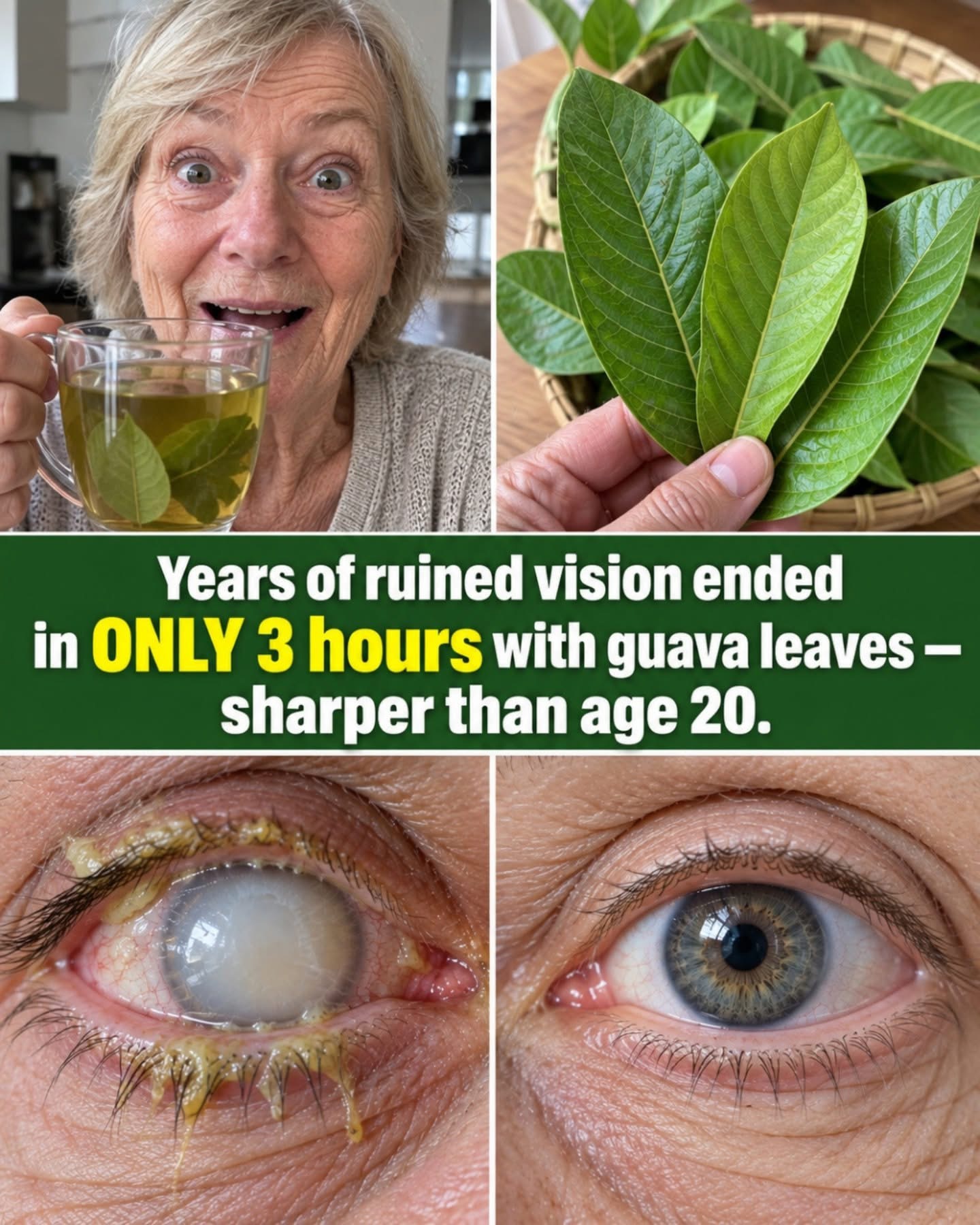
Guava leaves are being pushed as the thing that can wipe out blur, calm battered eyes, and bring back vision that feels sharper than it has in years. That’s a huge claim — especially when the post promises a change in only 3 hours and talks like ruined eyes can suddenly wake up.
And yet the reason people stop on a post like this is obvious: tired eyes are a daily punishment. The print on a receipt swims. The phone screen feels like it’s hiding behind a veil. By late afternoon, your eyes burn, water, and feel like they’ve been rubbed with sand.
What the health machine rarely says out loud is that your eyes are not failing in isolation. They’re the last warning light on a system that’s been running dry, inflamed, and underfed for far too long.

That’s where the real story starts.
The Eye Reset Hidden Inside a Leaf
The first thing guava leaves are doing is not “magic vision repair.” They’re flooding the body with sludge-clearing compounds that hit the circulation, the nerves, and the tiny vessels feeding the eyes. When those pathways are clogged, vision doesn’t just blur — it dulls, drags, and starts acting like a cheap camera lens smeared with grease.
Think of the eyes like the headlights on a car parked in a dust storm. The bulbs may still work, but if the glass is coated and the wiring is starving, the beam turns weak, scattered, and unreliable. That’s what a neglected visual system feels like from the inside.

Once those compounds start moving, the pressure changes. The first thing people notice is less of that hot, irritated feeling that makes you want to rub your eyes raw. Then the focus feels tighter, like the world has stopped swimming a little and started locking back into place.
The ugly truth is that most people keep hammering the eyes with more screens, more strain, more late-night light — then act surprised when the blur deepens. A leaf doesn’t just “support health.” It forces a different internal state, the kind that lets fragile tissue stop fighting for survival and start functioning again.
And that’s why nobody built a Super Bowl ad around a leaf. There’s no logo on a tree, no glossy campaign for something that grows quietly and costs next to nothing.

Why the Blurry, Burning Feeling Hits So Hard
When vision goes off, it rarely announces itself with a dramatic crash. It creeps in like a window getting fogged from the inside: first a little haze, then a stubborn smear, then the kind of blur that makes you lean toward the page without realizing it.
Guava leaves are being sold as the answer because they push fire-smothering compounds into the system. That matters when the eyes are irritated, because inflamed tissue behaves like a swollen hinge on a door — it still moves, but it grinds, sticks, and never feels smooth.
Picture waking up and not immediately reaching for the strongest reading glasses in the house. Picture looking across the room and not getting that split-second panic when faces or labels refuse to sharpen. That is the payoff people are chasing when they search for guava leaves in the first place.

The $100-billion wellness machine barely whispers about it. Why would it? You can’t patent a leaf that somebody can steep in a cup and use without asking permission from a pharmacy shelf.
Over time, the pattern gets clearer: less strain, less squinting, less of that exhausted feeling that makes your whole face tense up by dinner. The eyes stop acting like a warning siren and start acting like eyes again.
Why the Body Notices Before the Mirror Does
The second shift is subtle but powerful. Once circulation improves, the eye area stops feeling like a dead-end alley and starts receiving a hot river of fresh blood surging into dormant tissue. That means the tiny structures around the eyes get more raw biological fuel instead of limping along on scraps.
Use the wrong image and this is easy to miss: your eyes are not a decorative feature. They are high-demand tissue with more moving parts than most people ever think about, and they hate being starved. Starved tissue doesn’t just look tired — it performs like it.
So the after-picture is not just “better sight.” It’s opening the curtains in the morning without that immediate sting. It’s reading a menu without holding it at arm’s length. It’s walking into bright light without feeling like your eyes are being punished for existing.
The ugliest truth in health: the cheapest fix gets the least airtime. That’s why people keep buying complicated bottles while the produce aisle sits there like a locked vault full of overlooked tools.
And once the body has enough of the right compounds moving through it, the whole visual system stops fighting itself. The signal gets cleaner. The strain gets quieter. The day feels less like a battle with your own face.
Why Some People Feel the Shift in Their Whole Day
When the eyes are under siege, the rest of the day warps around them. You get headaches from squinting. You get irritable because everything takes more effort. You start avoiding bright rooms, tiny text, and any task that demands focus.
That’s why a guava-leaf routine is being framed as more than an eye trick. It’s a full system scrub that can change how the whole day feels, because vision problems don’t stay politely in the eyeballs — they leak into mood, energy, and concentration.
Think of a windshield with a film of oily grime on the inside. Wiping the outside helps a little, but the real problem is the hidden layer you keep driving through. Clear that, and the road looks different instantly.
That is the emotional payoff people are after: less friction, less dread, less of that sinking feeling when your own body starts making simple things hard.
And if the post’s promise sounds outrageous, that’s because it’s touching a nerve most people know too well. They’ve been told to accept weaker eyes as normal, as if blur and strain are just the price of living long enough.
They’re not.
The Part That Can Wreck the Whole Thing
One common kitchen habit neutralizes the punch before it ever reaches your bloodstream: blasting the leaves with boiling water and then walking away too soon. That turns the process into weak tea instead of a concentrated extraction, which means the body gets a watered-down version of the very compounds people are chasing.
There’s a better move, and it changes everything about how this works. The next layer is about pairing and preparation — because the right leaf, handled the wrong way, becomes just another cup of disappointment.
This article is for informational purposes only and does not replace professional medical advice. Please consult your healthcare provider for personalized guidance.